

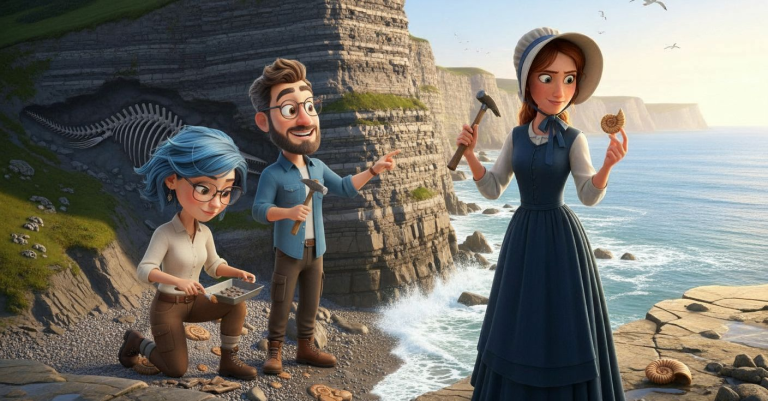
Mary Anning: The Girl Who Unlocked Ancient Secrets
Imagine Walking on a Beach Full of Dragons
Picture this: you’re walking along a rocky beach in England. The waves crash against the shore, and seagulls cry overhead. But this isn’t just any ordinary beach. Hidden in the cliffs are the bones of creatures that lived millions of years ago – sea monsters with enormous eyes, flying reptiles with leathery wings, and swimming giants with necks longer than a school bus! This is the story of Mary Anning, a brave girl who discovered these incredible fossils and changed science forever.
Mary lived over 200 years ago in a small seaside town called Lyme Regis. While other children her age were playing with dolls or marbles, Mary was hunting for dragon bones in the cliffs. Well, they weren’t really dragon bones – they were something even more amazing!
A Little Girl with Big Dreams
Mary Anning was born in 1799 in Lyme Regis, a town perched on England’s southwest coast. Her father, Richard, was a carpenter who loved fossil hunting. In those days, people didn’t know much about fossils. They called the spiral-shaped ammonites “snake stones” and made up stories about them being snakes turned to stone by magic!
Richard taught Mary to walk carefully on the beach and look for interesting shapes in the rocks. He showed her how to use a hammer and chisel safely. “Keep your eyes open, Mary,” he would say. “The sea gives up its secrets to those who know how to look.”
But when Mary was just 10 years old, tragedy struck. Her father died, leaving the family with very little money. Mary’s mother opened a small fossil shop to help make ends meet. Young Mary knew she had to help her family survive, so she took her hammer and headed to the dangerous cliffs.
Fun Fact!
Mary Anning was struck by lightning when she was just a baby! She was being held by a neighbor woman during a storm, and lightning hit them both. The woman died, but baby Mary survived and seemed even more alert and curious afterward. Some people said the lightning gave her special powers to find fossils!
The Discovery That Shocked the World
In 1811, when Mary was only 12 years old, something incredible happened. After a terrible storm had battered the coast, Mary and her older brother Joseph were searching the beach for anything valuable they could sell. Joseph spotted something unusual sticking out of the cliff – a skull with huge eye sockets, each as big as a dinner plate!
Mary knew this was special. For months, she carefully worked to free the rest of the skeleton from the rock. Day after day, she chipped away at the stone with tiny taps of her hammer. Tap, tap, brush. Tap, tap, brush. She had to be incredibly careful – one wrong move could destroy millions of years of history!
Finally, Mary revealed a complete skeleton that was 17 feet long! It had a body like a dolphin, four paddle-shaped limbs, and that enormous head with huge eyes and razor-sharp teeth. No one had ever seen anything like it before. Scientists later named it Ichthyosaurus, which means “fish lizard.”
Did You Know?
The ichthyosaur’s eyes were the size of dinner plates – bigger than any animal alive today! These huge eyes helped them hunt in the dark depths of ancient seas. They could probably see better underwater than any creature that has ever lived!
Life as a Fossil Hunter
Mary’s life was far from easy. Every day, she had to risk her life on the unstable cliffs. The rocks could crumble without warning, and the tide could trap her against the cliff face. She learned to read the weather like a book – dark clouds meant dangerous storms that could bring fresh fossils but also deadly rockfalls.
Her typical day started before dawn. Mary would pack her tools in a sturdy basket: hammers of different sizes, sharp chisels, and brushes for cleaning delicate bones. She wore heavy boots to grip the slippery rocks and carried a walking stick to test loose stones.
The work was backbreaking. Sometimes Mary would spend weeks carefully freeing a single skeleton from the rock. She had to work between the tides, racing against time as the sea crept closer. Her hands became tough and scarred from handling sharp rocks and metal tools.
Life Back Then
In Mary’s time, women weren’t allowed to join scientific societies or go to university. Most people thought women weren’t smart enough to understand science! Mary proved them wrong by becoming one of the most knowledgeable fossil experts in the world, even though she taught herself everything she knew.
The Sea Monster with the Long, Long Neck
In 1823, Mary made another earth-shaking discovery. She found a creature that looked like something from a fairy tale – a small head attached to an incredibly long neck that seemed to go on forever! The skeleton had a broad body with four huge flippers, like a sea turtle but much, much bigger.
When scientists first saw drawings of this creature, they couldn’t believe it was real. A famous expert in Paris declared it must be fake – surely someone had stuck several different skeletons together! But when other scientists came to examine Mary’s find in person, they confirmed it was genuine.
This creature was called a Plesiosaur, meaning “near lizard.” Some species had necks with over 70 vertebrae – that’s more than three times as many neck bones as a giraffe! Imagine a creature that could stick its head up out of the water like a periscope, scanning for fish while its massive body stayed hidden below!
Amazing Fact!
Some plesiosaurs were absolutely gigantic! The largest ones were longer than a modern blue whale. They ruled the ancient oceans for over 140 million years – that’s longer than dinosaurs walked on land!
Dragons in the Sky
Just when people thought Mary couldn’t surprise them anymore, she discovered something that seemed impossible – a flying dragon! In 1828, she found the delicate skeleton of a Pterosaur, a flying reptile with wings made of skin stretched between long finger bones.
This particular pterosaur, later named Dimorphodon, had a wingspan as wide as a small airplane. Its head was huge compared to its body, filled with sharp teeth perfect for catching fish. When Mary first uncovered it, local people whispered that she had found a real dragon!
The discovery proved that reptiles had once ruled not just the land and sea, but the sky as well. These weren’t birds – they were something completely different, with wings that worked like those of modern bats.
Incredible Discovery!
Mary found fossil squid ink that was so well-preserved, she could actually use it to write with! She would mix the ancient ink with water and draw pictures. Imagine writing with ink from a squid that lived 200 million years ago!
The Poop That Changed Science
Not all of Mary’s important discoveries were glamorous. She found strange rock formations that looked like stones but weren’t quite right. When she cracked them open, she found fish scales, bones, and other bits and pieces inside. Mary realized these were fossilized dinosaur droppings – ancient poop turned to stone!
Scientists gave these fossil droppings a fancy name: coprolites. They might sound gross, but they were incredibly important! By studying what ancient animals ate, scientists could understand how prehistoric food chains worked. Mary’s “poop rocks” showed that ichthyosaurs ate fish, squid, and sometimes even other ichthyosaurs!
Mary wasn’t embarrassed about studying fossil poop. She knew that every clue about ancient life was valuable, even the messy ones. Her practical approach helped scientists build a complete picture of prehistoric worlds.
Danger on the Cliffs
Fossil hunting was incredibly dangerous work. The cliffs at Lyme Regis are made of soft blue clay and limestone that crumbles easily, especially after storms. Mary had many close calls with falling rocks and landslides.
The most terrible day came in 1833. Mary was walking on the beach with her faithful dog, Tray, when she heard a deep rumbling sound. The cliff was about to collapse! She ran as fast as she could, but when the dust cleared, her beloved dog was gone, buried under tons of rock.
This tragedy could have ended Mary’s fossil hunting career, but she was too determined to give up. She continued her work, but with even more caution. She learned to read the tiny warning signs that meant danger – the sound of pebbles trickling down, the way the cliff face looked after rain, the feel of the ground under her feet.
Safety First!
Today, fossil hunters follow strict safety rules inspired by Mary’s experiences. They always hunt in groups, wear hard hats, check tide times, and never dig into cliff faces. The “Mary Anning Rule” is simple: fossils are amazing, but no fossil is worth risking your life for!
Fighting for Recognition
Even though Mary made world-famous discoveries, she often didn’t get the credit she deserved. When scientists published papers about “her” fossils, they sometimes forgot to mention her name. As a working-class woman in the early 1800s, she wasn’t allowed to join scientific societies or publish research under her own name.
But Mary didn’t let this stop her. She kept detailed notes about every fossil she found. She studied anatomy books and taught herself to read scientific papers in multiple languages. When famous scientists visited Lyme Regis, they quickly learned that Mary knew more about fossils than almost anyone in the world.
Slowly, Mary’s reputation grew. Scientists began to respect her expertise and ask for her opinions before publishing their research. She became an unofficial consultant to the greatest fossil experts of her day, even though she never received formal recognition.
Women in Science
Mary Anning paved the way for future women scientists. Her success proved that brilliant minds come in all forms, regardless of gender or social class. Today, there are thousands of women paleontologists around the world, and many of them were inspired by Mary’s story!
The Legacy Lives On
Mary Anning died in 1847 at the age of 47, but her impact on science was just beginning. The fossils she discovered helped prove that life on Earth had changed dramatically over millions of years. Before Mary’s discoveries, most people believed that all animals had always existed exactly as they were. Her prehistoric sea monsters showed that entire groups of creatures had lived and died long before humans appeared.
Mary’s work helped scientists understand extinction – the idea that species could completely disappear from Earth. This was a revolutionary concept that changed how people thought about life and time. Her discoveries were some of the key evidence that led to our modern understanding of evolution and prehistoric life.
Mary’s Museum
Today, you can visit the Lyme Regis Museum, built on the site where Mary’s family fossil shop once stood. The museum displays many of her original discoveries and tells her remarkable story. You can even walk the same beaches where she made her incredible finds!
Fossil Hunting Today
The Jurassic Coast where Mary worked is now a UNESCO World Heritage Site, protected for future generations of fossil hunters and scientists. Every year, thousands of people visit Lyme Regis to search for their own prehistoric treasures.
Modern fossil hunters follow in Mary’s footsteps, but with better safety equipment and scientific knowledge. They use GPS to map their finds, take detailed photographs, and work with museums to preserve important discoveries. Many amateur fossil hunters still make significant discoveries – just like Mary did over 200 years ago!
The tools haven’t changed much, though. Fossil hunters still use hammers, chisels, and brushes. The most important tool is still the same one Mary relied on: patience. Finding fossils requires hours of careful searching and gentle excavation work.
Try It Yourself!
- Visit a natural history museum to see fossil displays
- Look for fossils in your local area (with adult supervision)
- Try making your own “fossils” by pressing objects into clay
- Read about other famous paleontologists and their discoveries
What We Can Learn from Mary
Mary Anning’s story teaches us that anyone can make amazing discoveries if they’re curious, persistent, and brave enough to ask questions. She didn’t have fancy equipment or a university education, but she had something more valuable: an unstoppable desire to understand the world around her.
Mary also shows us the importance of careful, patient work. She could have rushed to dig up fossils quickly, but instead she took the time to preserve every detail. Her meticulous methods saved priceless scientific information that helped change our understanding of prehistoric life.
Most importantly, Mary never gave up, even when life was difficult and people didn’t take her seriously. She believed in the value of her work and continued pursuing her passion despite obstacles that would have stopped many others.
Mary’s Rules for Success
- Stay curious about everything around you
- Work carefully and patiently
- Don’t be afraid to challenge what everyone else believes
- Keep learning, even if you have to teach yourself
- Never give up on your dreams
The Adventure Continues
Every time you walk on a beach, climb a hill, or explore a rocky area, you’re walking through millions of years of Earth’s history. The ground beneath your feet holds stories of ancient oceans, prehistoric forests, and creatures that lived long before humans existed.
Mary Anning showed us that these stories are waiting to be discovered by anyone brave enough to look. You don’t need to be a professional scientist to make important discoveries – you just need curiosity, patience, and respect for the natural world.
Who knows? Maybe the next great fossil discovery will be made by someone just like you. The rocks are still full of secrets, and they’re waiting for the next Mary Anning to come along with a hammer, a keen eye, and an adventurous spirit!
The waves still crash against the cliffs at Lyme Regis, just as they did in Mary’s time. The stones still tumble down after storms, revealing new treasures from the ancient past. And somewhere out there, the next amazing discovery is waiting for someone curious enough to find it.
Remember Mary Anning’s lesson: the greatest adventures often begin with a single question and the courage to search for the answer.


