

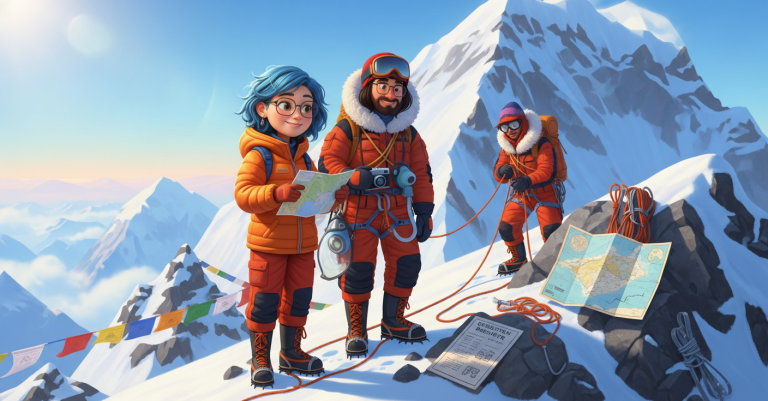
The Tiny Climber Who Conquered the World’s Tallest Mountain
Imagine Standing Where No Woman Had Ever Stood Before
Picture this: You’re standing on a small hill in Japan, looking up at the sky. The houses below look like toy blocks, and you feel something magical stirring in your heart. Now imagine that same feeling, but you’re standing higher than airplanes fly – on top of Mount Everest, the tallest mountain on Earth! This is exactly what happened to a quiet girl named Junko Tabei, who became the first woman ever to reach the summit of Mount Everest.
Ben and Pia from “Let’s Rewind!” are excited to share this incredible adventure with you. It’s a story about courage, friendship, and never giving up – even when the whole world seems to be against you. So grab your warmest imaginary jacket, because we’re heading to places where the air is so thin that every breath is precious!
A Little Girl with Giant Dreams
In the 1940s, in a town called Fukushima, Japan, lived a girl who was smaller than most of her classmates. While other children played with dolls or toys, Junko Ishibashi (who would later become Junko Tabei) stood in the schoolyard staring at the hills around her town. Her heart would beat faster every time she looked up at those rocky slopes.
When Junko was just ten years old, her school organized a trip to climb a nearby mountain. It wasn’t a giant peak – just a small hill really – but for little Junko, it might as well have been Mount Everest! As she climbed higher and higher, her legs burned and her breathing became heavy. But when she reached the top and looked down at her town spread out below like a miniature model, something incredible happened.
The world looked completely different from up there! The houses seemed like dollhouses, and she could see paths and roads she’d never noticed before. In that magical moment, a seed was planted in Junko’s heart – the seed of a mountain climber.
Fun Fact!
Japan is actually a very mountainous country! About 73% of Japan is covered by mountains. Mount Fuji, Japan’s most famous peak, is 12,389 feet tall – that’s pretty high, but still less than half the height of Mount Everest!
Growing Up in a World That Said “No”
As Junko grew older, she faced a big problem. In the 1950s and 1960s, many people in Japan believed that women should stay home, get married, and take care of families. The idea of a woman climbing dangerous mountains seemed absolutely crazy to most people!
But Junko couldn’t ignore the call of the mountains. While studying English literature at university in Tokyo, she would save every coin she could to buy climbing gear. Her boots were old and used, her backpack was patched and worn, and her gloves were so cheap that the cold bit right through them. But none of that mattered to her.
Every weekend and holiday, Junko would head to the mountains around Tokyo. The rocks would scrape her hands, snow would soak through her thin socks, and sometimes she’d slip and fall. But each time she reached a summit – no matter how small – she felt that same incredible joy she’d experienced as a ten-year-old girl.
Life in 1960s Japan
When Junko was young, Japan was rebuilding after World War II. Most people traveled by crowded trains, and life was quite difficult. Women were expected to have very traditional roles. The idea of a woman going on dangerous adventures was so unusual that people would stare and whisper!
The Birth of an All-Women Climbing Team
The worst part wasn’t the cold or the dangerous climbs – it was what some of the male climbers would say. Some men would make jokes when Junko struggled with a heavy backpack. Others would say that women were too weak for “real” mountains, or even suggest that women only joined climbing clubs to find husbands!
These comments hurt Junko’s feelings, but they also made her determined. In 1969, she made a decision that would change everything. She created the Joshi Tozan Club – the Ladies Climbing Club. Their motto was bold and simple: “Let us go on an overseas expedition by ourselves.”
The club started with just a few women – office workers, teachers, and students who all shared the same dream. They would meet on weekends to practice tying knots, climbing rocks, and carrying heavy packs. When they fell in the snow, they would laugh, brush themselves off, and try again. They were building something special: a team powered by patience, friendship, and stubborn determination.
Did You Know?
- The word “Joshi” means “women” in Japanese
- Junko had to sew her own climbing gloves because good equipment was so expensive
- The women practiced by carrying bags of rice to simulate heavy mountain packs
- They would train in Tokyo’s city parks, drawing curious stares from passersby
The Impossible Dream Takes Shape
By 1975, Junko and her Ladies Climbing Club had an incredible goal: Mount Everest! This wasn’t just any mountain – it was the tallest peak on Earth, standing 29,032 feet high (that’s almost six miles straight up!). The summit sits right on the border between Nepal and Tibet, where the air is so thin that your body slowly starts to shut down.
At that time, fewer than 100 people had ever reached the summit of Everest – and every single one was a man. Many people thought it was impossible for women to survive in such extreme conditions. The cold could freeze your fingers in minutes, the wind could knock you off narrow ridges, and avalanches could bury entire camps without warning.
But Junko and her team were determined to try. They planned to use the same route that Edmund Hillary and Tenzing Norgay had taken in 1953 – the southeast ridge route through Nepal. The expedition would include 15 Japanese women climbers, with Junko as the leader, helped by experienced Sherpa guides from the Himalayas.
Everest Facts That Will Blow Your Mind!
- Mount Everest is still growing! It gets about 4 millimeters taller every year
- The mountain has two different names: “Everest” (named after a British surveyor) and “Sagarmatha” in Nepali, meaning “Goddess Mother of the World”
- The temperature on the summit can drop to -76°F (-60°C) – cold enough to freeze your breath instantly
- Climbers need to carry oxygen bottles because above 26,000 feet, there’s only one-third as much oxygen as at sea level
The Money Challenge
Having a dream is one thing, but making it happen is another! Climbing Everest costs an enormous amount of money. The team needed special gear, airplane tickets, permits, food, and oxygen bottles. Each piece of equipment had to be perfect – one broken zipper or torn glove could mean the difference between life and death.
Junko became incredibly creative at raising funds. She visited kindergartens and asked for small donations. She sewed her own gloves and jacket, stuffing them with down feathers from old sleeping bags. Some sponsors thought the idea of women climbing Everest was so strange that they refused to help. But slowly, coin by coin and donation by donation, the team gathered enough money for their expedition.
The dedication was incredible. Team members would skip buying new clothes, give up treats, and work extra hours just to contribute to the expedition fund. They knew they were working toward something that had never been done before in history.
Journey to the Bottom of the World’s Tallest Mountain
In spring 1975, Junko said goodbye to her husband Masanobu (who was also a climber and supported her dream) and their young daughter. At the airport, reporters surrounded her with flashing cameras and asked why a mother would risk her life on such a dangerous mountain. Junko answered quietly but firmly: “I climb because I love mountains, not because I want to be famous.”
The journey to Everest was an adventure in itself. First, the team flew to Kathmandu, Nepal’s capital city. The air there smelled of cooking fires and dust, and colorful prayer flags fluttered from buildings. Then came the trek to Everest Base Camp – a journey that takes about two weeks on foot!
They walked through amazing villages where people live completely differently than in Japan. They saw yaks (huge, hairy mountain animals) carrying heavy loads while their bells jingled with each step. As they walked higher and higher, the trees became smaller and eventually disappeared completely, leaving only rock, ice, and snow.
Amazing Sherpa Culture
The Sherpa people are the real heroes of Everest! They live in the mountains and know them better than anyone else. Sherpas carry incredibly heavy loads, set up camps, and fix ropes that keep climbers safe. Many Sherpas can climb to high altitudes much easier than people from other places because their bodies have adapted over many generations. Without Sherpa guides, almost no one could climb Everest!
Base Camp: The Last Stop Before Danger
After two weeks of walking, the team finally reached Everest Base Camp at 17,600 feet. This became their home for many weeks. Imagine camping in your backyard, but the ground is made of ice that creaks and moves all night long, and the air is so thin that just walking to the bathroom leaves you breathing hard!
The camp was a small city of colorful tents scattered across the rocky glacier. Prayer flags snapped in the constant wind, and the ice under their feet would groan and crack as it slowly moved down the mountain. At night, Junko would lie in her sleeping bag listening to these strange sounds, her heart full of excitement, fear, and determination.
From Base Camp, they could see their route up the mountain. First came the terrifying Khumbu Icefall, then the Western Cwm (a valley of ice), then the steep Lhotse Face, and finally the summit ridge. Each section had its own deadly challenges.
The Khumbu Icefall: A Frozen Obstacle Course of Death
The first major challenge was the Khumbu Icefall – imagine a frozen waterfall made of ice blocks the size of houses! These blocks, called seracs, can fall without warning, crushing anything below. Deep cracks called crevasses open up like monster mouths, some so deep you can’t see the bottom.
The team had to cross this dangerous maze using aluminum ladders as bridges over the crevasses. Picture walking across a ladder stretched over a gap so deep that if you fell, no one would ever find you! Junko wore crampons (sharp metal spikes) on her boots and used an ice axe to pull herself up the steep parts.
Every step was slow and careful. The ice would moan and shift under their feet, and sometimes huge chunks would break off with a sound like thunder. But step by step, the team fixed ropes and established camps higher up the mountain – Camp One, then Camp Two in the Western Cwm.
Crevasse Rescue Facts
Crevasses are incredibly dangerous! Some are over 100 feet deep and hidden under thin layers of snow. Climbers always rope together so if one person falls into a crevasse, the others can pull them out. The deepest crevasse ever measured on Everest was over 800 feet deep – that’s taller than most skyscrapers!
Higher and Higher: Into the Death Zone
From Camp Two, the route went up the Lhotse Face – a wall of ice so steep it’s almost vertical! Imagine climbing up the side of a frozen skyscraper while wearing a heavy backpack and breathing air that’s thinner than on an airplane. Junko would kick her crampons into the hard blue ice, swing her axe above her head, and pull herself up inch by inch.
They established Camp Three on this steep face, then finally reached Camp Four at the South Col, around 26,000 feet high. Above this height lies the “death zone” – a place where the human body literally starts to die from lack of oxygen. Your heart beats incredibly fast, your head pounds with pain, and every movement feels like running a marathon.
But the most dangerous part of their journey was still ahead. On May 13, 1975, while the team was resting at a lower camp, Mount Everest showed its deadly power.
When the Mountain Attacked
It started as a quiet night. Stars shone coldly above the jagged peaks, and Junko curled up in her sleeping bag, exhausted from days of climbing. Then the wind began to whisper, then howl, then scream across the ice. Snow started falling, hitting their tents like thousands of tiny hammers.
Suddenly, with a roar louder than a freight train, an avalanche thundered down from above. A massive wave of snow and ice crashed over their camp like a frozen tsunami. Tents were smashed, buried, and thrown around like toys in a tornado.
Junko’s tent collapsed on top of her, and she was buried under tons of heavy, wet snow. She couldn’t see, couldn’t move her arms or legs, and could barely breathe. For terrifying minutes, she was trapped in a cold, white prison, thinking about her daughter far away in Japan.
But her teammates and Sherpa guides dug frantically with their bare hands and shovels. Finally, after what felt like hours but was probably only minutes, Junko was pulled free, coughing and gasping in the thin air.
Avalanche Survival Facts
- Most avalanche victims have only 15 minutes before the snow freezes solid around them
- The weight of avalanche snow is incredibly heavy – one cubic foot can weigh up to 80 pounds
- Survival depends on creating an air pocket around your face and staying calm
- Rescue dogs can smell people buried under 15 feet of snow
The Choice: Give Up or Keep Going?
Junko was badly shaken by the avalanche. Her legs and back ached with pain, and she had to rest for two full days while her body recovered. Several other team members and Sherpas were also injured, though thankfully no one was killed.
As she lay in her repaired tent, wrapped in blankets and listening to snow melt hissing on the stove, Junko faced the biggest decision of her life. She could turn back – and no one would blame her. The mountain had given her a clear warning. She could go home safely to her daughter and husband.
But as she listened to her body and her heart, Junko realized she had come too far and trained too hard to give up now. The dream of standing on the summit still burned inside her, not wild like a fire, but steady like a lantern in the darkness. She decided to continue, but more carefully than ever.
The Final Push to the Top of the World
After recovering from the avalanche, the team planned their summit attempt. Only a few people could go to the very top, to save oxygen and strength. Junko was chosen, along with Ang Tshering, an experienced Sherpa climber who had been to high altitudes many times before.
On May 16, 1975, they left Camp Four on the South Col for the final climb. The world around them was almost empty of color – just white snow, dark rock, and pale sky. Above 26,000 feet, every single step felt like lifting a huge weight. Their oxygen masks hissed softly, feeding their lungs the precious air they needed to survive.
Junko moved incredibly slowly, counting steps in her mind. Ten steps, then stop and rest. Ten more steps, then rest again. She remembered being that little girl on the hill in Fukushima, taking her very first climb. The mountain was much more dangerous now, but the feeling was exactly the same – upward, step by step, against fear and gravity.
Standing Where No Woman Had Ever Stood
They climbed past the South Summit, a high point before the true top. From there, the final ridge looked terrifyingly narrow – like walking on a tightrope stretched between the sky and two countries. On one side was Nepal, on the other was Tibet. One wrong step could mean a fall of thousands of feet.
Junko forced her exhausted legs to keep moving. The air was so thin that even turning her head made her dizzy. They passed the Hillary Step, a steep rocky section that was one of the final obstacles. Then, amazingly, the ground began to level out under her boots. There was nowhere higher to go!
On May 16, 1975, at 12:35 PM, Junko Tabei became the first woman in history to stand on the summit of Mount Everest.
She didn’t shout or wave her arms wildly – she was too tired for that, and the place felt too sacred. Instead, she took a few photographs to prove the climb, then looked out over the curved edge of the Earth. Clouds lay far below like a white ocean, and she could see for hundreds of miles in every direction.
Summit Success Statistics
When Junko reached the summit in 1975, only about 100 people had ever stood on top of Everest – and she was the very first woman! Today, over 6,000 people have reached the summit, and about 20% of them are women. Junko opened the door for all of them!
The Dangerous Journey Down
Reaching the summit was only half the challenge – now they had to get down safely! The descent was just as dangerous as going up, maybe more so because they were exhausted. Junko and Ang Tshering moved carefully, step by step, crossing back over all the dangerous sections where climbers had fallen in the past.
When they finally reached the lower camps, their teammates greeted them with tears of joy and relief. The news traveled around the world incredibly fast. In Japan, newspaper headlines announced that a Japanese woman had climbed Everest. Many people had thought such a thing was impossible!
But Junko knew that the climb was never hers alone. It belonged to her entire team, to the brave Sherpas who had helped fix the route and carry supplies, and to everyone who had supported her dream – from the kindergarten children who donated coins to her husband who believed in her adventure.
Coming Home to a Changed World
When Junko returned to Japan, she was amazed by the attention she received. Reporters wanted to interview her about everything from the food she ate on the mountain to whether she wore makeup during the climb! She was surprised that many people seemed more interested in her being a woman than in the actual climbing achievement.
But something wonderful was happening. Girls in schools saw her picture and learned that a woman had stood on the world’s highest point. Some parents began talking to their daughters differently, realizing that maybe women could take great risks and lead big expeditions too. Doors that had been closed began to open, just a little bit at first.
Junko accepted honors and awards, but she wasn’t interested in being famous. She was already looking toward the horizon, planning her next mountain adventure.
The Seven Summits Challenge
After Everest, Junko decided to climb the highest mountain on every continent! This is called the Seven Summits challenge. She climbed Denali in North America (20,310 feet), Aconcagua in South America (22,838 feet), Kilimanjaro in Africa (19,341 feet), Mount Elbrus in Europe (18,510 feet), Vinson in Antarctica (16,050 feet), Carstensz Pyramid in Australia/Oceania (16,024 feet), and of course Everest in Asia. She was the first woman to complete this incredible challenge!
Teaching Others to Reach High
As Junko grew older, she became passionate about sharing her love of mountains with others. She organized climbing trips for children and people who had never seen a real mountain before. She taught them about safety, respect for nature, and the patience needed to reach any goal.
She also became worried about what was happening to the mountains she loved. As more and more people climbed famous peaks like Everest and Mount Fuji, they left behind trash – old oxygen bottles, torn tents, food packaging, and other garbage. Junko organized cleanup climbs, where teams would go up mountains specifically to pick up this litter and bring it down.
For Junko, loving mountains also meant protecting them for future generations to enjoy.
A Gentle Teacher with a Powerful Message
In her later years, Junko often visited schools to talk to children. She would stand in front of rows of curious faces – she was small, with a gentle smile, not at all like the tough heroes from action movies. She would tell simple stories about being scared on steep slopes and about the joy of reaching a summit after hours of hard work.
One of the most important things she would tell children was that she was never naturally strong or athletic. In fact, she was often weak and got sick easily when she was young. What kept her going wasn’t a special body, but a determined mind and the belief that one step at a time could take you very far.
Her voice was soft, but her words carried incredible power. Children would go home thinking differently – not just about mountains, but about any big dream they might have. Most of them would never climb Everest, but they would face their own challenges someday, and they would remember her story of quiet persistence.
Environmental Legacy
- Junko led over 40 cleanup expeditions on Mount Fuji alone
- She founded a foundation to protect mountain environments
- She studied environmental science to better understand how to protect mountains
- She believed that climbers had a responsibility to leave mountains cleaner than they found them
The End of an Incredible Journey
Junko Tabei lived until 2016, when she was 77 years old. Even when she became ill with cancer, she kept climbing smaller mountains whenever she felt strong enough. Friends remember that she was modest about her world records and preferred to talk about future adventures rather than past achievements.
During her lifetime, the mountain world changed dramatically. More and more women joined expeditions, mixed teams became normal, and skill became more important than gender. Mount Everest became crowded – sometimes too crowded – which brought new problems and dangers.
Through all these changes, Junko’s story remained inspiring. A quiet girl from Fukushima, who once stood alone staring at a small hill, had opened a path to the roof of the world for everyone who came after her.
Her Story Lives On in Every Dream
Today, Junko’s name is written in history books and record books around the world. But the most important part of her legacy isn’t written anywhere – it lives in the heart of every person who feels small but chooses to climb anyway.
Her story teaches us that you don’t have to be the strongest or the tallest or the loudest person to achieve incredible things. You just need to love what you’re doing, respect the people around you, and never give up on your dreams. Whether your “mountain” is learning a new skill, trying out for a team, standing up to a bully, or anything else that seems impossible, remember Junko’s secret: one steady step, then another, can take you higher than anyone ever believed possible.
Every time a girl looks up at a mountain – or any other challenge – and thinks “Maybe I can do that too,” Junko’s spirit is there, smiling quietly and saying, “Of course you can. Just take it one step at a time.”
Mountains Are Still Calling!
Junko’s story reminds us that adventures are everywhere, waiting for anyone brave enough to take the first step. You might not climb Everest, but you can climb the hills near your home, explore the forests in your area, or even just walk to the top of the tallest building in your town. The important thing is to start somewhere, respect nature, and never stop dreaming about what’s possible!


